
Securing Digital Trust: The Fight Against Deepfakes & Disinformation
15 July 2026 - A Weekly Publication by New North Ventures

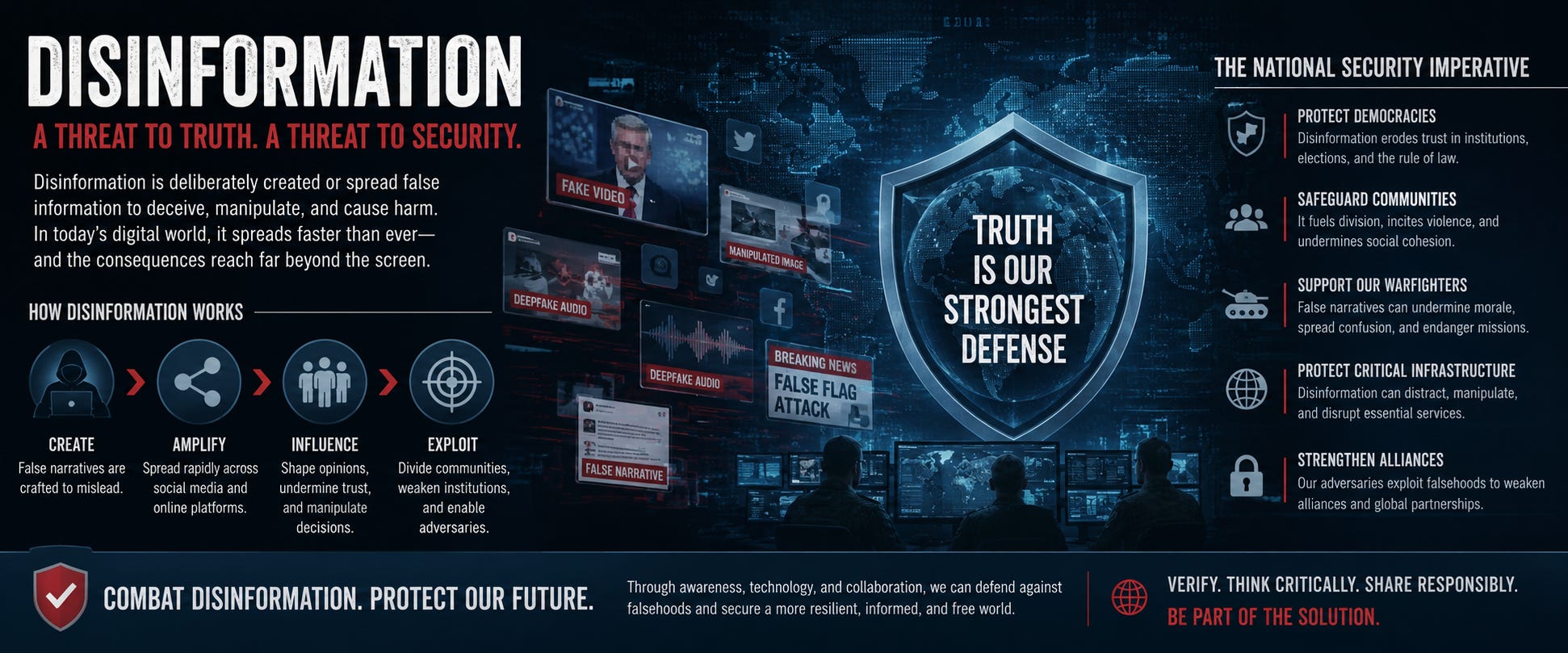
Before diving in, it's worth distinguishing between two terms that are often used interchangeably. Misinformation is false information shared without the intent to deceive, while disinformation is intentionally created or spread to manipulate, mislead, or influence behavior. As AI generated content and deepfakes become increasingly convincing, the line between the two is becoming harder to detect. This creates new risks for governments, businesses, and national security.
Emerging Market Quadrant for Deepfake Detection — Startup Vendors
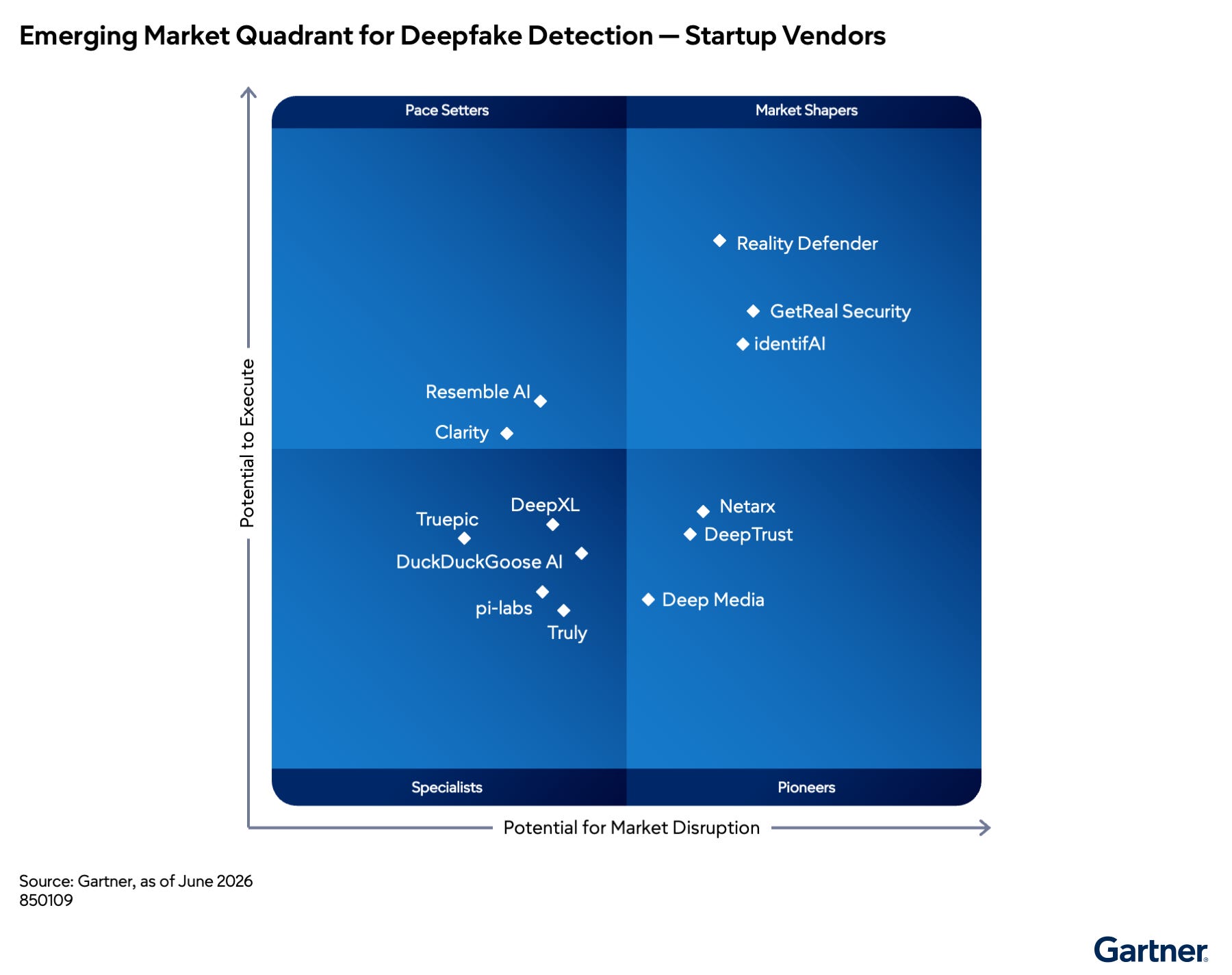
Gartner frames deepfake detection as an emerging but fast maturing cybersecurity discipline. It is the ability to detect, analyze, and forensically examine fabricated or AI manipulated images, audio, video, and live interactions meant to deceive or disinform. The report urges C-level executives to treat deepfakes as a major cybersecurity risk and evaluates startups on their ability to deliver continuous, cryptographic, forensic grade detection. It splits the vendor landscape into four groups plotted on “Potential to Execute” and “Potential for Market Disruption”: Market Shapers (Reality Defender, GetReal Security, and identifAI), Pace Setters (Resemble AI and Clarity), Pioneers (Netarx, DeepTrust, and Deep Media), and Specialists (pi-labs, Truepic, DuckDuckGoose AI, DeepXL, and Truly).
On strategy, the report identifies three distinct commercialization approaches vendors are pursuing. The first is an ecosystem embedded strategy that weaves multimodal forensic detection directly into clients’ infrastructure via free API access (though this risks commoditization as larger cybersecurity suites absorb baseline detection). The second is a hardware anchored strategy that anchors cryptographic provenance at the physical sensor level for verifiable, tamper proof truth. The final is domain specific interception approach, building highly targeted defenses for specific channels like remote hiring pipelines or live synthetic audio at the endpoint. Looking forward, Gartner expects disinformation security standards (akin to MITRE ATT&CK, via frameworks like DISARM) to emerge, and predicts organizations will build dedicated “digital trust and authenticity platforms” (DTAPs) run by new “TrustOps” teams.
Reality Defender, a New North Ventures portfolio company, is named a Market Shaper, Gartner’s top-tier category for vendors combining the strongest disruptive technology with the strongest go-to-market execution. Market Shapers are distinguished by multimodal ensemble models that scrutinize audio, video, image, and text simultaneously, paired with forensic signals intelligence and threat propagation graphs, embedded into continuous operational workflows. A case example in this quadrant, closely mirroring the executive-impersonation fraud scenario Reality Defender itself has publicized, describes a multinational enterprise targeted by real-time video/audio deepfakes on a live executive videoconference to authorize a fraudulent transfer, resolved by natively embedding multimodal detection into the conferencing platform to catch pixel and audio inconsistencies and block the transaction before execution. Gartner does flag risks even for top-quadrant vendors, though: buyers should watch for platform commoditization, ensure vendors offer genuine proprietary forensic depth rather than easily bypassed pattern recognition, and avoid over-relying on a horizontal, generalized platform if their organization has specialized vulnerabilities better served by domain specific vendors elsewhere in the quadrant.

Aging Pipes, Cyber Threats, and Disinformation: The Battle for America’s Water Security
America’s aging, underfunded water infrastructure, over 2 million miles of pipes, 9-12+ million lead service lines, and widespread PFAS contamination, has become a national security vulnerability, not just an environmental one. Using Jackson, Mississippi’s recurring water crises as a case study, it shows how deferred maintenance, funding gaps, and environmental justice disputes create the kind of divisive, emotionally charged conditions adversaries like China, Russia, and Iran can exploit. The EPA has also documented rising cyberattacks on water systems from actors including Iran’s IRGC, pro Russia hacktivists, and Chinese state sponsored groups like Volt Typhoon, with over 70% of inspected systems found in violation of basic cyber hygiene standards.
The disinformation angle is central: adversaries don’t need sophisticated hacking to cause damage, they can simply amplify real grievances or fabricate false ones about negligence or contamination to erode trust and trigger panic. The article cites a January 2024 incident where a false social media claim that Jackson’s treatment plant had shut down triggered a run on water that overwhelmed the system’s pressure, forcing a boil water notice for 12,000+ residents. That was a single fake post causing real physical strain with no hacking involved. Since water systems are widespread, locally run (93% serve fewer than 10,000 people), and already burdened by real problems tied to race and poverty, they offer a low cost way for adversaries to sow distrust and destabilize communities. The author’s recommendations tie funding, cybersecurity, and information security together, calling for federal agencies to work with state, local, and utility partners on counter disinformation strategies alongside infrastructure investment.
US and South Korea launch first wartime fake news drill
The US and South Korea held their first ever joint tabletop exercise focused specifically on countering foreign disinformation in a wartime scenario. Hosted at the South Korean Joint Chiefs of Staff headquarters in Yongsan, Seoul, the drill brought together the JCS and U.S. Forces Korea, along with personnel from the United Nations Command and the South Korea U.S. Combined Forces Command. Notably, it was the first time military commands partnered with a broad range of civilian government sectors for a unified “whole-of-government” response, with South Korea’s defense, foreign, and culture ministries all helping shape strategies against “cognitive warfare.”
The training centered on three main areas: countering foreign disinformation by identifying and dismantling hostile propaganda in real time; synchronizing allied defenses across cyber, space, and electromagnetic domains; and aligning strategic communications to keep public messaging consistent between allies. Military leaders framed control of the information environment as a top strategic priority for the alliance going forward, and officials are now looking at incorporating these communication and defense strategies into larger live action joint military exercises planned later this year.
More links to explore:
Marine Corps drafting new strategic vision for its information warfare arm
Pentagon announces ‘immediate suspension’ of CMMC Phase II mandates

Hubble Pushes Satellite Network For Long-Range Bluetooth
New North Ventures invested in Hubble Network in 2023. Recently Co-Founder and CEO Alex Haro joined Bloomberg Businessweek to discuss the future of Bluetooth and the space economy.
Alex Haro explained how the company has overcome one of the biggest limitations of Bluetooth, its traditionally short range, to enable direct communication with satellites in orbit. Rather than transmitting large amounts of data like headphones or speakers, Hubble optimized Bluetooth for small, high value data packets, such as asset location and status updates, and paired it with proprietary, highly sensitive space based antennas capable of detecting these weak signals from Earth. The result is a network that allows existing Bluetooth devices to connect to satellites without any hardware modifications, dramatically expanding connectivity for Internet of Things (IoT) applications. Haro highlighted commercial use cases across fleet management, construction, mining, oil and gas, and defense, noting that customers like Samsara can enable satellite connectivity through a simple software update. As Hubble continues building out its satellite constellation following launches with SpaceX and other providers, the dual-use company has raised more than $100 million in venture funding and is currently raising additional capital to expand its global network.
Thanks for reading Securing Our Future! Subscribe for free to receive new posts and support our work.