
Orbital Infrastructure: Computing Moves to Space
1 July 2026 - A Weekly Publication by New North Ventures

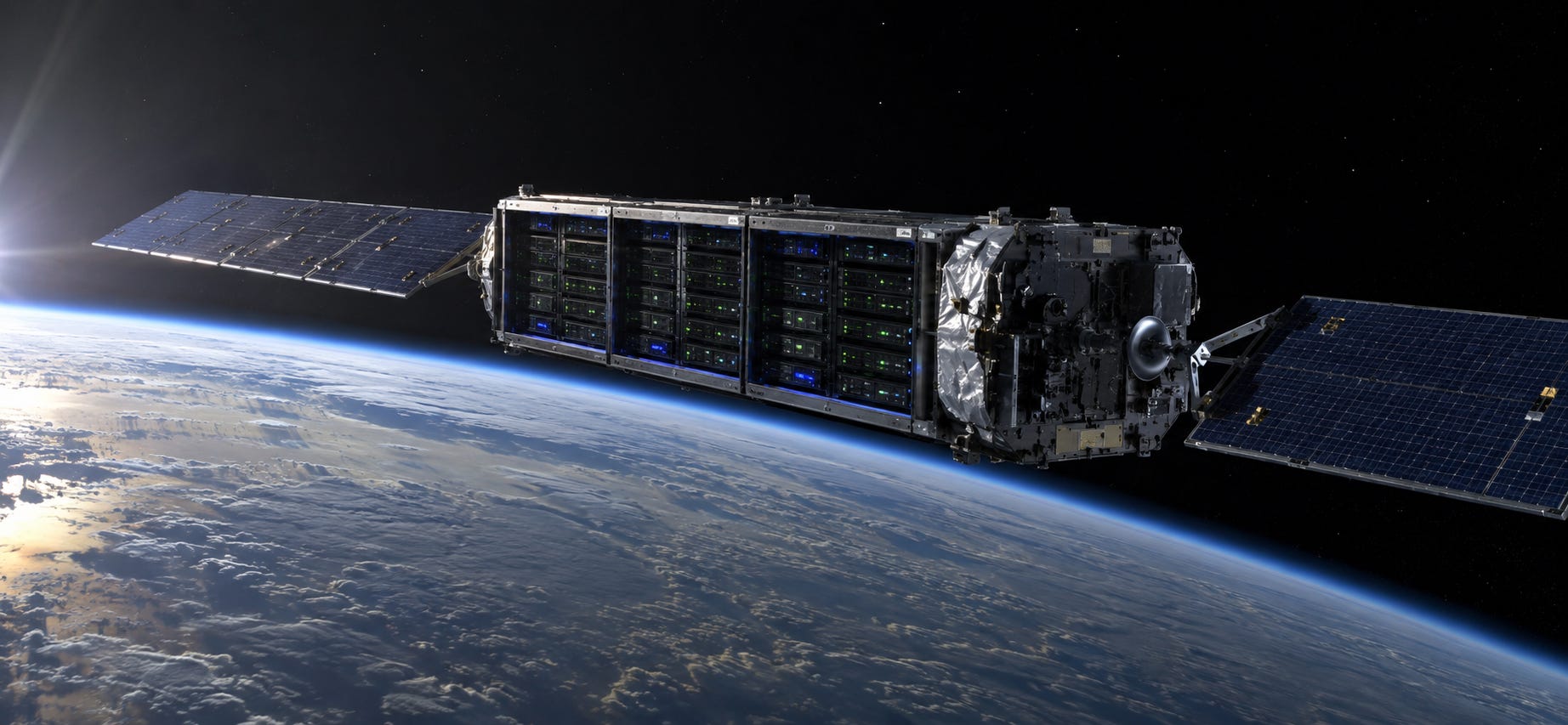
Orbital files plans for 100,000 orbital data centers
Five-month-old startup Orbital has asked the Federal Communications Commission for permission to deploy up to 100,000 data center satellites, aiming to bring 10 gigawatts of computing power from space to meet rising artificial intelligence demand. The filing represents one of the most ambitious orbital infrastructure proposals to date and signals a fundamental shift in how the defense and commercial sectors are thinking about compute infrastructure. Rather than viewing satellites as communications or sensing platforms, Orbital is positioning space as the next frontier for raw computational capacity, particularly for power intensive AI workloads that are increasingly constrained by terrestrial energy, cooling, and regulatory limitations.
The scale is striking. At 100,000 satellites and 10 gigawatts of power, Orbital is proposing an orbital compute constellation that rivals the entire terrestrial hyperscale data center footprint of a major cloud provider. The company is betting that space offers unique advantages for AI training and inference: near unlimited solar power, natural thermal management through radiative cooling, reduced latency for globally distributed workloads, and insulation from terrestrial infrastructure vulnerabilities. This is not incremental optimization. Orbital compute is being designed explicitly to serve AI workloads, which are the single largest driver of infrastructure demand in both commercial and defense contexts today.
The broader implication for defense investing is that the boundary between space infrastructure, AI, and national security is collapsing. Orbital compute constellations will be attractive to defense and intelligence users for workloads that require airgapped processing, sovereign compute isolation, or persistent overhead presence. They also introduce new categories of vulnerability and resilience, from space based cyber defense to on-orbit fault tolerance. For early stage investors, the signal is clear: the next generation of defense infrastructure will not be built on the ground, it will be built in orbit. The companies enabling that shift, whether through launch, power systems, thermal management, networking, or the compute platforms themselves, represent the infrastructure layer beneath every future defense AI capability.

Buckle Up: The Bad Guys Now Have A Model As Powerful As Mythos
A significant shift has occurred in AI powered cybersecurity: China has released an open weight AI model with offensive cyber capabilities comparable to Anthropic’s restricted Mythos model. Unlike Mythos, which remains tightly controlled because of its ability to autonomously discover software vulnerabilities and generate exploits, the Chinese model is publicly available. This means nation states, cybercriminals, and other malicious actors can freely access advanced offensive cyber capabilities. This could dramatically lowers the barrier to conducting sophisticated cyberattacks and marks a new phase in the AI arms race, where powerful cyber tools are no longer confined to a handful of leading AI labs.
The article also highlights the growing geopolitical implications of frontier AI. While U.S. companies have emphasized strict safeguards around their most capable models, China’s decision to openly release a similarly powerful system underscores the tension between AI safety and strategic competition. Restricting access to advanced models in democratic countries may no longer prevent misuse if comparable capabilities are readily available elsewhere. As a result, governments, critical infrastructure operators, and enterprises will need to accelerate investments in AI enabled cyber defense, assuming that attackers now have access to tools capable of discovering and exploiting vulnerabilities at unprecedented speed and scale.
NASA races to save Swift telescope from falling back to Earth with daring rescue mission
NASA is launching a first-of-its-kind $30 million robotic satellite servicing mission to rescue its aging Neil Gehrels Swift Observatory, which has been in orbit since 2004. Increased solar activity has expanded Earth’s upper atmosphere, creating more drag and causing Swift’s orbit to decay much faster than expected. To prevent the telescope from reentering the atmosphere, startup Katalyst Space Technologies will launch its LINK servicing spacecraft aboard a Northrop Grumman Pegasus XL rocket. LINK will autonomously rendezvous with Swift, capture it using robotic arms, and gradually raise its orbit from roughly 224 miles to 373 miles, extending the observatory’s operational life by several years.
Beyond saving a scientifically valuable telescope, the mission represents a major milestone for the emerging on-orbit servicing industry. Rather than replacing expensive space assets, operators may soon be able to repair, refuel, or reposition satellites already in orbit. If successful, the Swift rescue would move orbital servicing beyond one time demonstrations into a practical commercial capability, paving the way for future life extension missions for satellites.
More links to explore:
NASA, SBA Announce New Initiative to Scale American Space Economy
Google’s VC arm backs ex-Axiom Space CEO’s $30M bet to build a stock exchange for space

Psionic Selected by NASA Under the 2025 Announcement of Collaboration Opportunity (ACO)
Psionic has been selected by NASA as one of 37 U.S. companies participating in the agency’s 2025 Announcement of Collaboration Opportunity (ACO), a program that gives innovative commercial companies access to NASA’s facilities, hardware, software, and technical expertise to accelerate technologies for future lunar and Mars missions. The collaboration underscores NASA’s continued investment in next generation commercial space capabilities.
Through the partnership, Psionic will work with NASA’s Armstrong Flight Research Center to flight test its Navigation Doppler Lidar (NDL) technology, which enables precise navigation in GPS denied environments by measuring velocity and range. Successful validation could help advance autonomous navigation systems for future lunar landers and human exploration missions to the Moon and Mars.
Thanks for reading Securing Our Future! Subscribe for free to receive new posts and support our work.