
Maritime Autonomy: Venture Scale Investment
10 June 2026 - A Weekly Publication by New North Ventures

The Venture Capital Case for Maritime Autonomy
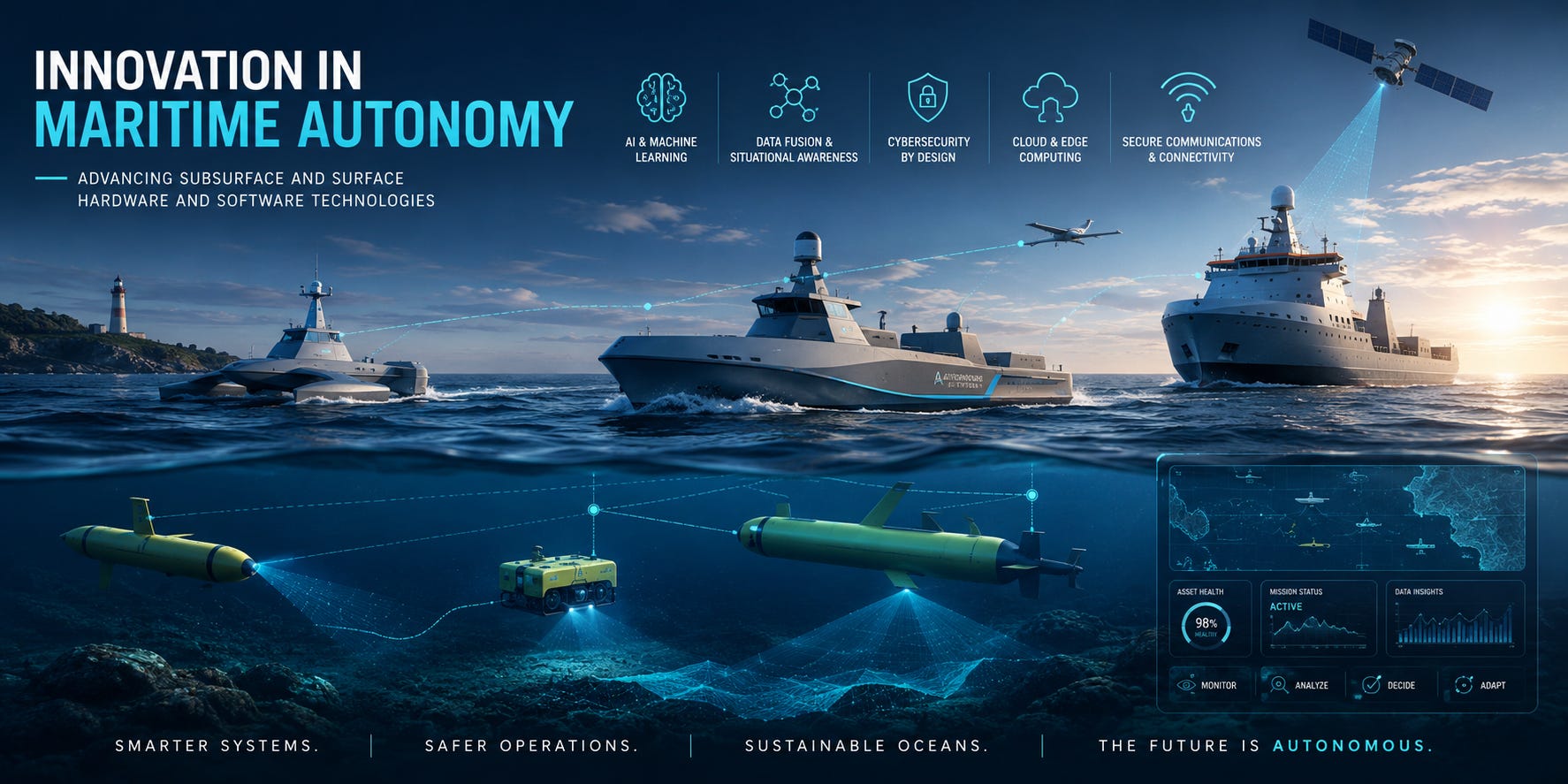
When we look at the maritime industry, we like to break it down into two main categories: unmanned undersea and unmanned surface maritime technology, where both categories include hardware and software solutions. What has changed over the last several years is that maritime autonomy has evolved from a niche defense market into a venture scale investment category. Growing geopolitical competition, particularly in the Indo-Pacific, the Red Sea, and other contested waterways, has transformed both the ocean surface and undersea environment into critical zones of military competition. As a result, governments are allocating significantly more resources and capital toward autonomous maritime capabilities that can provide persistent surveillance, logistics, mine countermeasures, anti-submarine warfare, and distributed lethality at a fraction of the cost of traditional crewed platforms. The U.S. Navy alone continues to expand investments in unmanned maritime systems and broader fleet modernization efforts.
The buyer universe has also expanded considerably. In addition to traditional defense customers such as the U.S. Navy, SOCOM, and allied maritime forces, strategic acquirers now include large defense primes, shipbuilders, autonomy software providers, and dual-use technology companies seeking to operate across land, air, sea, and undersea domains. This is creating a much more active merger and acquisition environment as companies race to build all-domain autonomous capabilities rather than develop every component internally. Recent examples include Havoc AI’s expansion of its maritime autonomy platform to land, sea and air, reflecting a broader industry trend toward acquiring or integrating technologies that enable cross-domain operations.
Capital formation is accelerating alongside acquisition activity. Havoc AI recently raised $85 million, bringing total funding to nearly $100 million in less than two years, while Blue Water Autonomy raised a $50 million Series A after an earlier $14 million seed round. Booz Allen recently invested in maritime company Ulysses as part of their recent Series A round. Other strategic investors such as Lockheed Martin, Hanwha, and In-Q-Tel are increasingly investing directly into maritime autonomy companies, signaling both customer demand and future acquisition interest. As autonomous maritime systems prove operationally effective and become programs of record, we expect acquisition timelines to compress, strategic premiums to increase, and consolidation to accelerate. Similar to what occurred in the drone and defense software markets over the past decade, maritime autonomy is rapidly becoming a core layer of future military capability and one of the most attractive emerging categories for venture backed defense technology.
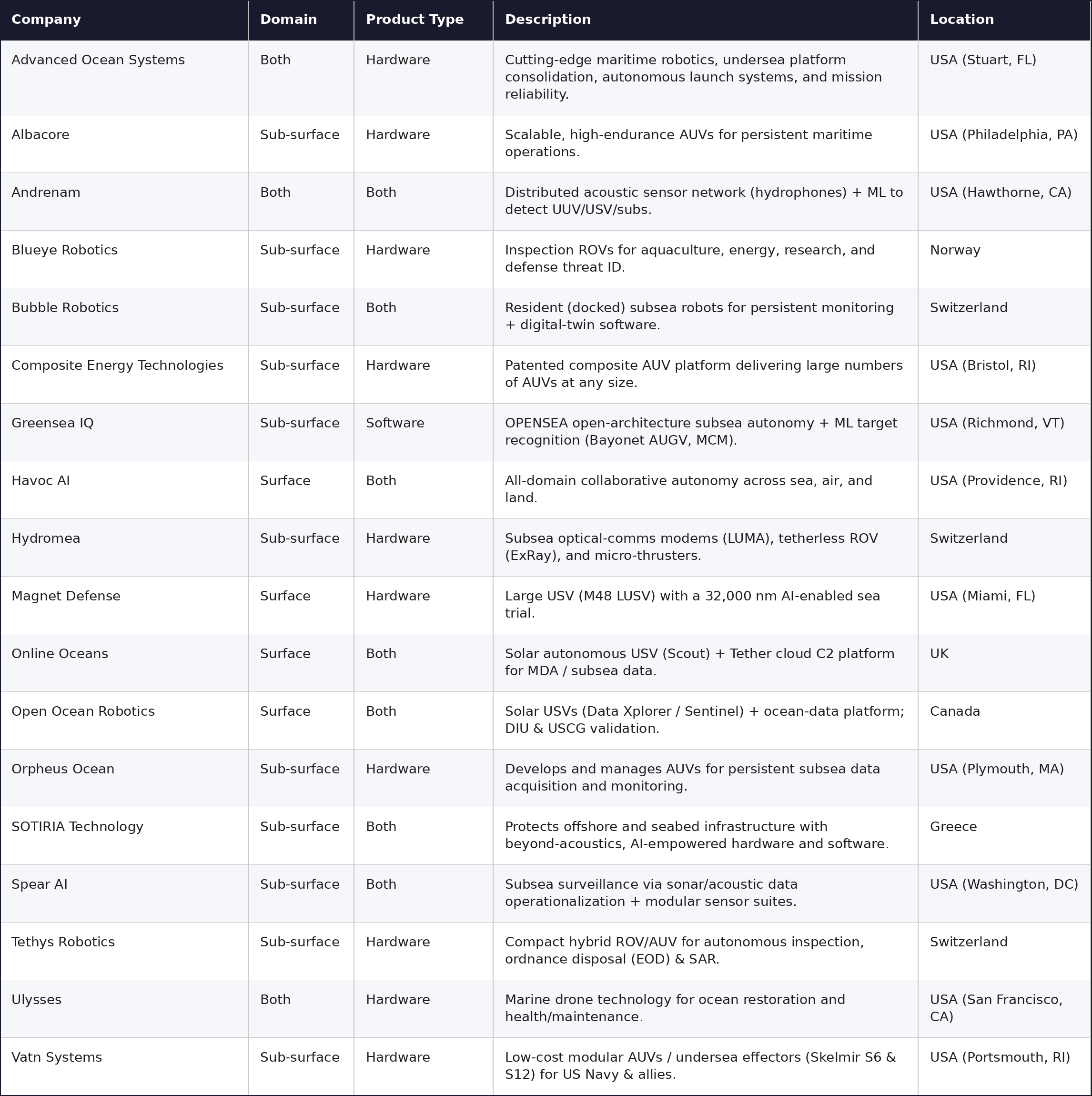
We have recently seen several interesting companies and wanted to highlight some companies that are building in the maritime space below. If you are a pre-seed or seed company building in this domain, reach out! We would like to learn more.

Op-Ed: Maritime Cybersecurity is a Financial Investment
The article frames maritime cybersecurity as a core financial investment rather than a discretionary IT cost. Modern shipping and port operations are deeply digitized, with vessels relying on interconnected systems for navigation, engine control, cargo handling, communications, and port coordination. This connectivity expands the attack surface, making ships and maritime infrastructure increasingly attractive targets for cybercriminals and state actors. The author emphasizes that even relatively simple intrusions, such as tampering with AIS data or accessing onboard systems, can create real operational disruption and expose sensitive commercial and security information.
The central argument is that the economics of cyber risk in maritime are now impossible to ignore. A single cyber incident can lead to costly vessel downtime, delayed cargo, supply chain disruption, and reputational damage that cascades across global logistics networks. Yet many operators still underinvest in cybersecurity relative to the scale of exposure. The piece contends that treating cybersecurity as a line item operating expense underestimates its return profile: modest, consistent investment in cyber defenses can prevent disproportionately large losses, reduce operational risk, and strengthen resilience across increasingly software-driven maritime systems.
More links to explore:

ZeroFox and Reality Defender Partner to Close the Synthetic Media Gap in External Threat Protection
ZeroFox and Reality Defender have formed a partnership to address the growing risk of AI generated “synthetic media” being used in cyberattacks. The integration embeds Reality Defender’s deepfake detection capabilities directly into the ZeroFox external threat protection platform, allowing security teams to identify whether images, audio, or video content used in impersonation and social engineering campaigns has been artificially generated. The goal is to close a gap in traditional external threat workflows, which can detect malicious infrastructure but often cannot verify the authenticity of media itself. By adding real time multimodal detection inside ZeroFox’s existing “Discover, Validate, Disrupt” workflow, analysts can more quickly confirm and respond to impersonation attempts involving executives, brands, or other high value targets. The companies argue this will improve accuracy, reduce time to takedown, and help organizations better defend against increasingly realistic AI driven fraud and misinformation campaigns.
Thanks for reading Securing Our Future! Subscribe for free to receive new posts and support our work.