
From Ukraine to the Pentagon: The Global Acceleration of Autonomous Warfare
6 May 2026 - A Weekly Publication by New North Ventures

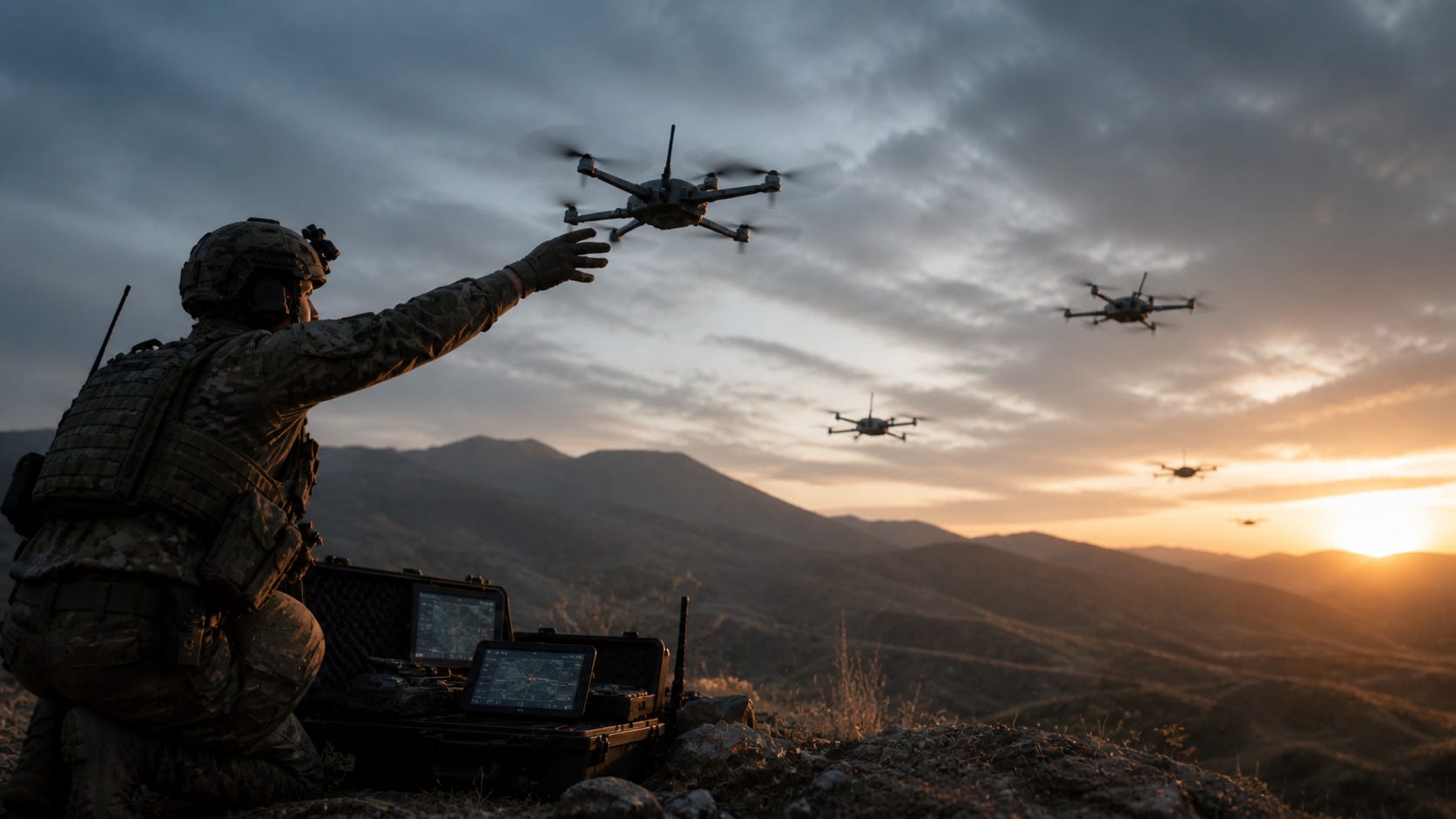
The Strongest Demand Signal in Defense: Inside the Pentagon’s $54B Autonomous Push
Every defense budget cycle has a headline number, some big round figure that gets quoted in press releases and argued over in appropriations hearings. The FY27 budget has one too: $1.5 trillion in total proposed defense spending. Buried inside that number is a single line item that deserves far more attention than it feels like it’s getting. The Defense Autonomous Warfare Group, or better known as DAWG, was allocated $226 million in FY26. In the FY27 request, that number becomes $54.6 billion.
That is a 24,167% increase in a single fiscal year. Not a rounding error. Not a spreadsheet anomaly. A deliberate, historic, structural shift in how the Pentagon intends to fight wars going forward.
For a bit more context: the entire FY25 budget request for the United States Marine Corps was $53.7 billion. DAWG, a program office that stood up less than two years ago, was requested more funding than it costs to run an entire military service for a year. The broader Pentagon drone budget for FY27 is approximately $74 billion, DAWG accounts for roughly 73 cents of every dollar in that envelope.
The budget architecture is worth understanding. Of the $54.6 billion, only $1 billion sits in the standard base defense budget. The remaining $53.6 billion comes from the proposed $350 billion defense reconciliation package, making DAWG alone approximately 15 percent of that entire legislative vehicle. That structure is both a feature (bypassing the slow onboarding of normal appropriations) and a political variable (reconciliation has to pass).
Budget requests are not appropriations, and a number this large, concentrated in a single relatively new program office, will attract scrutiny, if it hasn’t already. This scrutiny will come both from members who think it’s necessary and from those who view it as a politically convenient way to run defense spending outside normal oversight.
The budget numbers are unprecedented. What’s equally significant is the conceptual shift driving them.
In a previous article, we described Army Secretary Dan Driscoll outlining an ambitious vision for rapidly expanding America’s drone capabilities. Central to that goal is a fundamental cultural shift, drones should no longer be treated as accountable equipment signed out of an arms room, but as expendable ammunition consumed in the field. For investors and founders, that reclassification matters: it signals a move toward high volume, low cost, attritable systems rather than expensive long lifecycle platforms.
What this means for the DIB: the DAWG allocation is a flashing green light.
The Pentagon has effectively pre-announced its largest technology priority for the next several budget cycles. The funding request creates a demand signal of extraordinary scale for companies operating in the autonomous systems stack. From airframes and propulsion to the sensors, communications, edge computing, and software layers that make machine swarms militarily effective, the time is now for the DIB to show how we can absorb and distribute such a demand signal.
Here’s the bottom line, this doesn’t just seem like a line item in another tedious bill, this seems more doctrinal. A 24,167% investment increase in one particular capability (or set of capabilities) is how the world’s largest investor signals a strategic pivot that they believe is irreversible.
Whether that bet is right, whether the execution of the DIB can match the ambition of the DOW, and whether Congress will ultimately authorize the full scope of what’s been requested are all legitimate open questions. But the direction that they’d like to head isn’t ambiguous. Whether you are building or investing in autonomous systems, now is the time and the demand is here.

Autonomy To Rule The Seas? Retired Admiral Provides Analysis
In this Defense News interview from the 2026 Sierra Space Conference, retired Admiral James Foggo discusses how autonomy is fundamentally reshaping naval warfare. He argues that unmanned systems, spanning surface vessels, undersea platforms, and aerial assets, are becoming central to how modern navies achieve awareness, deterrence, and operational reach. These systems allow forces to extend sensing and presence across vast maritime areas while reducing risk to sailors in highly contested environments.
Foggo emphasizes that autonomy is no longer experimental or niche, but is actively being integrated into real fleet concepts and operational planning. Advances in artificial intelligence, sensor fusion, and secure communications are accelerating this shift, enabling autonomous platforms to operate with greater independence and coordination. He frames this as a transition from isolated unmanned experimentation to distributed, networked maritime systems that can scale across theaters.
He also highlights that future maritime dominance will depend on a hybrid force structure, where crewed ships and autonomous systems operate together as a cohesive network. In this model, speed of decision making, data advantage, and the ability to deploy large numbers of low cost autonomous assets will matter as much as traditional platform capability. Foggo suggests that navies that fail to adapt to this shift risk losing both operational tempo and strategic advantage in future conflicts.
Eyewitness to war: Ukraine’s DIY drones defy Russian jamming
Ukraine’s war effort has rapidly turned into a large scale experiment in decentralized, “DIY” drone warfare, where inexpensive, rapidly assembled systems are reshaping frontline combat. The article highlights how Ukraine’s ecosystem blends civilian engineers, small workshops, and commercial components to build FPV and reconnaissance drones at scale, enabling continuous adaptation under battlefield pressure. These systems are widely used for surveillance, artillery spotting, and direct strikes, giving Ukrainian forces persistent visibility over Russian positions while keeping costs extremely low.
A key theme is that Ukraine’s advantage comes less from any single platform and more from its speed of iteration. Because components are widely available and production is distributed, designs can be modified and re-deployed quickly in response to Russian electronic warfare and jamming. This creates a constant cycle of adaptation on both sides, with each new countermeasure quickly followed by a workaround, especially in areas like frequency hopping, fiber optic links, and low cost FPV deployments.
Overall, the conflict is an accelerating technological arms race in which electronic warfare and drone innovation are tightly intertwined. Rather than a decisive breakthrough in autonomy or mass production, the battlefield is defined by continuous improvisation, with Ukraine’s open, flexible production model allowing it to sustain rapid innovation even under intense attrition and pressure.
More links to explore:

Reality Defender Targets Enterprise Demand for Deepfake Incident Response Framework
Reality Defender is positioning itself as an early leader in enterprise deepfake security by launching a Deepfake Incident Response Playbook, a structured, four tier framework that helps organizations detect, contain, and respond to synthetic media threats embedded in everyday workflows. The company is moving beyond pure detection to operationalizing deepfake risk inside security teams, particularly around high risk vectors like identity verification and executive impersonation.
This highlights the growing enterprise demand for these capabilities as deepfakes increasingly target core business processes. For investors, this positions Reality Defender to benefit from rising cybersecurity spend in AI-driven threats, with potential upside from deeper integration into security stacks, stronger enterprise adoption, and pricing power in a rapidly emerging category.
The American Hawkeye 360 intends to increase its value to $2.4 billion as part of the IPO
HawkEye 360 is preparing for an IPO that could value the company at up to $2.4 billion, with plans to raise around $400 million by offering shares expected to be priced at $24–$26 per share. The company operates a constellation of satellites that collect and analyze radio frequency data, serving U.S. government and allied defense customers.
The planned listing reflects strong growth and rising demand for space based intelligence, as governments increase investment in defense and monitoring capabilities. HawkEye 360 is aiming to capitalize on improving IPO market conditions and growing investor interest in national security and space tech companies.
Thanks for reading Securing Our Future! Subscribe for free to receive new posts and support our work.