
From Seed to S-1: A Breakout In Defense Tech
15 April 2026 - A Weekly Publication by New North Ventures


New North Ventures portfolio company HawkEye 360 has officially filed its S-1, marking a major milestone not just for the company, but for the broader defense tech ecosystem. The company, a pioneer in RF geospatial intelligence, has built a category defining platform that tracks and analyzes radio frequency signals from space, serving both government and commercial customers. This filing represents one of the clearest signals yet that dual-use companies can scale into public market ready businesses while maintaining deep ties to national security missions.
From an early-stage investor standpoint, this moment matters. For years, the biggest question around defense tech has been: what are the exits? HawkEye 360’s IPO trajectory helps answer that. It demonstrates that companies rooted in government demand, historically seen as slow, bureaucratic, or non-scalable, can in fact build durable, high growth businesses with diversified revenue streams. It also reinforces that technical moats in areas like space based sensing and data analytics are both defensible and valuable in public markets.
More broadly, this fits into a growing trend. Over the past few years, we’ve seen a steady drumbeat of defense and dual-use companies access the public markets, either through traditional IPOs or alternative paths. The signal to founders and investors is clear: the pathway from early stage innovation to liquidity is becoming more defined. This has the potential to unlock more capital and talent in the sector.
| Founded 2015 | Space Based RF Geospatial Intelligence | ~200+ Employees |

What they do
Operates 30+ satellites that detect and geolocate radio frequency signals such as radars, jammers, satellite phones and ship transponders
First commercialized space based SIGINT platform; meaningfully differentiated from imagery focused players like Planet or BlackSky
Business model: data-as-a-service (subscriptions + analytics) with high gross margins on unclassified work products
Capex intensity is decreasing as the constellation matures; targeting 30–40% YoY growth while maintaining profitability
Revenue mix:
U.S. Government (~50%)
Customers include NGA, NRO, CIA, and combatant commands
Short sales cycles, sometimes hours to get on contract
Shorter contract terms; high volume of engagements
International (~50%)
Allied nations across dozens of countries
Longer sales cycles due to ITAR/FMS process, but stickier relationships and premium pricing
$131M FMS deal with India for maritime domain awareness is a flagship example
Financing
Series E at ~$2B valuation - $150M+ round co-led by NightDragon and Center15 Capital
$173M total raised
Revenue trajectory: $30.5M (2022) → $67.6M (2024) → $117.7M (2025)
Sources: Pitchbook, S-1
Why it matters
First company to operationalize large scale RF signal mapping from space at commercial scale
Addresses a capability gap no imagery satellite can fill: signal detection vs. visual observation
Crossed into profitability with a $303M backlog representing 6× growth

Momentum is building around the signed reauthorization of the SBIR/STTR programs, one of the most important funding pipelines for early stage deep tech and defense startups. The program, which allocates billions annually across federal agencies, has long served as a non-dilutive bridge between research and commercialization. Recent commentary from policymakers emphasizes not just renewal, but modernization to ensure the program remains competitive in a rapidly evolving innovation landscape.
The data underscores its importance: SBIR/STTR collectively deploys over $4 billion per year into small businesses, often serving as the first institutional capital a startup receives. Increasingly, these dollars are flowing into dual-use technologies in AI, autonomy, space, advanced manufacturing that align with national security priorities. Reauthorization provides continuity, but the real opportunity lies in improving transition rates from Phase I/II funding into procurement and scaled deployment.
The Evolution of Modern Weapon Systems
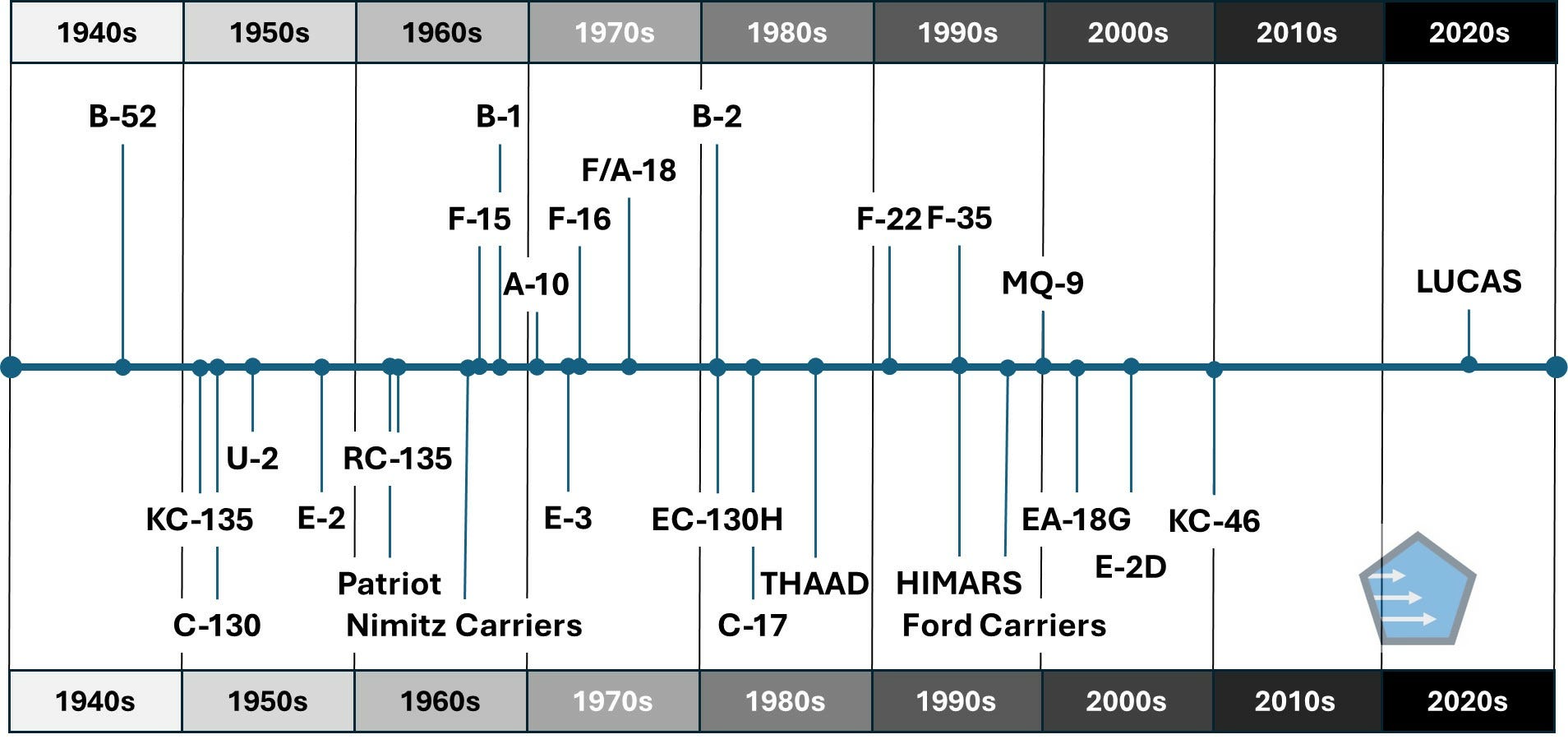
The timeline of modern military systems highlights both strength and inertia. Many of today’s core platforms such as bombers, fighters, and transport aircraft were originally designed decades ago and have been continuously upgraded to stay relevant. That longevity speaks to incredible engineering, but it also masks how slowly entirely new systems have been fielded.
Recent commentary from defense leaders underscores a growing realization: in a world of peer competition, electronic warfare and autonomous systems, iteration speed matters as much as capability. The challenge isn’t that the U.S. lacks advanced tech, it’s that adversaries are moving faster, deploying newer systems, with compressed timelines and in ways that traditional acquisition hasn’t kept pace with.
What’s changing now is the shift toward speed as a core advantage. Autonomous systems, software defined platforms, and modular architectures are enabling faster deployment and continuous upgrades. The future isn’t about replacing every legacy system overnight, it’s about building a force that can adapt in real time, with innovation cycles measured in months, not decades (Timeline by Pete Modigliani).
More links to explore:
SpaceX isn’t the only defense tech IPO that VCs should care about
After Swarmer’s Soaring Debut, Here Are 12 Other Potential Defense Tech IPOs

Auriga Space charges up the launch game
Auriga Space is pushing forward on a critical bottleneck in the space economy: responsive and flexible launch infrastructure. The company is developing mobile launch capabilities designed to increase cadence and reduce dependency on fixed launch sites. This is an increasingly important factor as demand for satellite deployment continues to rise.
Recent progress highlights growing momentum behind this model. As governments and commercial players alike seek more resilient space architectures, the ability to launch quickly, from multiple locations, becomes a strategic advantage. Auriga is positioning itself squarely at that intersection, helping enable a more dynamic and responsive space ecosystem.
Thanks for reading Securing Our Future! Subscribe for free to receive new posts and support our work.