
From Artemis to Acquisition: Securing the Earth–Moon Economy
13 May 2026 - A Weekly Publication by New North Ventures

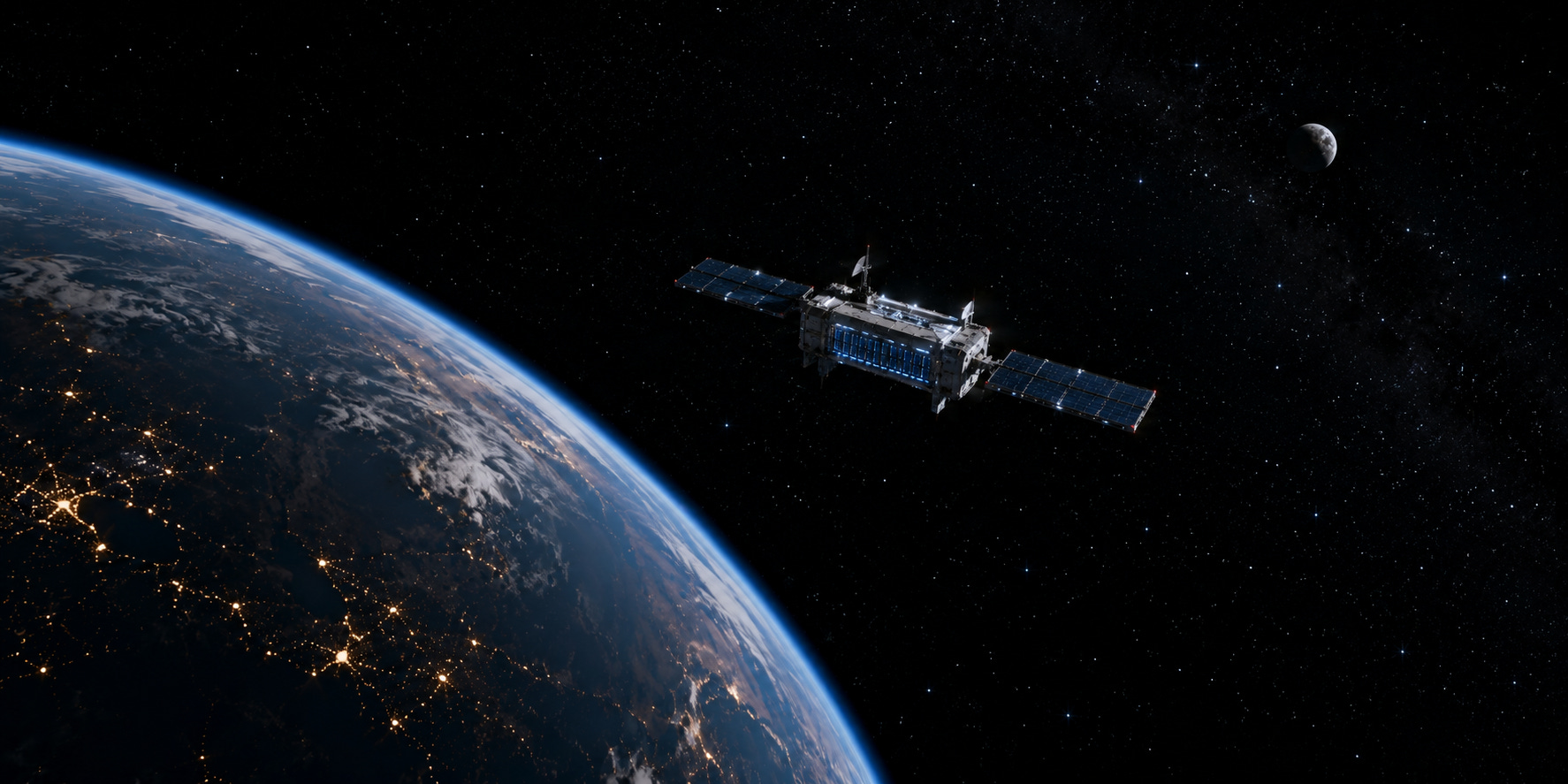
Increased Demand For Innovation In Cislunar Capabilities
Last month, a crew of four astronauts successfully completed a historic journey around the Moon and back. Marking the first time humans have ventured that deep into space since 1972’s Apollo 17 mission, the flight was a true demonstration of America’s bold Space program. On April 1, Reid Wiseman, Victor Glover, Christina Koch, and Jeremy Hansen of the CSA launched from Kennedy Space Center, eventually reaching a record breaking distance of 252,756 miles from Earth and passing within 4,067 miles of the lunar surface. By April 10, they safely splashed down in the Pacific, returning in such great health that all four were able to walk off the recovery ship unassisted.
This was amazing for so many reasons, 54 years later “Still got it” America’s Space Program says like a former college basketball player says when draining a 3. From a defense lens, what’s so interesting is that the U.S. Space Force announced it was standing up a dedicated office to figure out how the military fits into whatever comes next in the Earth-Moon system. The juxtaposition between NASA proving humans can survive the journey, and the Space Force immediately asking who secures it is the story of cislunar right now.
On April 15, at the annual Space Symposium in Colorado Springs, Maj. Gen. Stephen Purdy, the senior advisor to the Secretary of the Air Force for space acquisition, announced the creation of the Cislunar Coordination Office, an acquisition task force whose mission will be to build the roadmaps for acquiring cislunar capabilities. Purdy made explicitly clear that this wouldn’t be an exploratory working group, this would be a collaborative effort to ensure we build out a roadmap for cislunar activity and then begin coordinating with industry.
It’s not surprising that we hear the Department of War going in this direction after President Trump’s executive order Ensuring American Space Superiority in December of 2025. The direction from this executive order establishes that America will have begun constructing the “initial elements of a lunar outpost by 2030” and thereby extends the DOW’s defined area of responsibility through to lunar space.
Although the executive order does not explicitly call for a military base on or around the Moon. What it does is mandate a sustained U.S. architecture, to include transportation, communications, and navigation, which by our estimation, inherently carries security implications.
Here is what most coverage of the Space Force’s cislunar ambitions breezes past: cislunar space is technically challenging in ways that GEO (Geosynchronous Orbit) and LEO (Lower Earth Orbit) are not, and the gap between the Space Force’s current toolset and what cislunar demands is significant. The fundamental issue lies in that the traditional orbital mechanics and toolsets can’t be used in cislunar like they can be in GEO and below. The moon’s gravitational influence starts to play a role once you get to the cislunar regime. The commercial space industry will be needed, and just like the Defense Industrial Base has been tasked with in so many ways before, a new blueprint will need to be created. What companies will dare to be part of such a challenging problem? What companies will dare to deal with such a vast area of responsibility?
Although Artemis II wasn’t a military mission, it changed the overarching strategic calculus by the DOW and specifically the USSF. For five decades, the Moon was inert from a national security standpoint, sure it was scientifically interesting, but militarily, it was irrelevant. As habitats start to form, infrastructure starts to be built, communication and power systems start to exist on or near the moon, there will become a need to monitor, protect, and in a contested scenario, defend them, and that is inherently a Space Force problem.
The Cislunar Coordination Office’s stated intent to partner with industry is significant, and the timing, coming immediately after Artemis II and within months of the December executive order, suggests the government is serious about moving from planning to procurement. They’ll define the capability gaps. They likely won’t be abstract impossibilities, but rather, well-defined and acquirable technology areas.
For investors paying attention to the defense-space intersection, the pattern here rhymes strongly with how SDA developed at proliferated LEO. Early government investment in domain awareness created the acquisition architecture that commercial operators eventually fed into. The companies building cislunar relevant capabilities now are positioning early for what will likely become a meaningful acquisition category by the late 2020s.
The Space Force has 9,000 Guardians. The entire organization could fit in a high school football stadium. It cannot build cislunar alone. The question is not whether the Space Force will be in the Earth-Moon theater, it will, it’s surely established that. The question is whether the companies of the current Defense Industrial Base will move fast enough to matter, because others will and we’ll be on the lookout for them!

Amazon vs. SpaceX: The High-Stakes Battle for Space Internet | WSJ
The race to dominate low Earth orbit (LEO) satellite internet is accelerating, with Amazon attempting to close the massive gap between its satellite initiative and SpaceX’s rapidly expanding Starlink network. Amazon has launched roughly 300 satellites so far for its LEO business, despite being authorized to deploy more than 7,000, while SpaceX has already launched approximately 12,000 Starlink satellites into orbit. LEO satellites, generally operating between about 100 and 1,200 miles above Earth, offer major performance advantages because signals travel shorter distances, resulting in faster internet connectivity for users on the ground. The video also notes that major space assets including the International Space Station and the Hubble Space Telescope operate in LEO, underscoring how strategically important this orbital region has become for both commercial and government activity.
The market opportunity for global broadband connectivity is enormous, with a SpaceX executive previously estimating the addressable market at roughly $1 trillion annually. Still, scaling a LEO network comes with major challenges. Unlike traditional geostationary satellites positioned more than 22,000 miles from Earth, LEO systems require thousands of satellites to provide comparable global coverage. Another challenge is that much of the Earth’s surface is ocean, limiting the number of traditional household customers directly beneath satellites at any given time. As a result, operators are aggressively targeting maritime and aviation customers including container ships, cruise lines, and airlines to maximize network utilization. Investors continue to see strong upside in the sector, with Goldman Sachs projecting the LEO satellite market could grow to approximately $108 billion by 2035, while Starlink is expected to become a major driver of SpaceX’s valuation and anticipated IPO plans.
Tech giants race to build space data centers to power AI boom
As AI demand pushes terrestrial power grids to their limits, major technology companies are increasingly looking to space as the next frontier for compute infrastructure. The article highlights how SpaceX, Google, Nvidia, Amazon, and Meta are exploring space based data centers powered by solar energy. Elon Musk recently predicted orbital data centers could become viable within “two to three years,” using networks of low Earth orbit satellites equipped with GPUs and connected via laser communications to operate as one massive AI compute cluster. The appeal is compelling: solar generation in space can be five to eight times more efficient than on Earth, while the near freezing conditions of space could dramatically reduce cooling costs for energy intensive AI servers.
Early efforts are already underway. Nvidia backed startup Starcloud successfully launched a satellite carrying Nvidia H100 GPUs that is already running Google’s Gemma AI model in orbit, and the company now plans to build a massive 5 gigawatt orbital data center. Meanwhile, Google is developing its “Project SunCatcher” satellite compute network, while Meta recently signed a deal to source up to 1 gigawatt of space generated solar power for AI infrastructure. The urgency is clear: the International Energy Agency projects global data center electricity consumption could reach 950 terawatt hours annually by 2030, equivalent to the output of roughly 120 nuclear power plants. While launch costs, radiation exposure, and space debris remain major hurdles, the article frames orbital compute infrastructure as a serious long term solution to the growing AI energy crisis.
More links to explore:
The Space Economy: Mapping 86 Companies Across 11 Subsectors
DIU Projects | Project TitanCore - Modular Data Centers for AI Compute

Havoc Raises $100M Series A to Power the Future of All-Domain Collaborative Autonomy
Havoc AI, a portfolio company of New North Ventures, announced a $100 million Series A round to accelerate the development of its all domain collaborative autonomy platform across maritime, air, and ground systems. The raise brings the company’s total funding to roughly $200 million since 2024 and included participation from major defense and technology investors including Lockheed Martin and SAIC. Havoc’s software enables a single operator to coordinate large fleets of autonomous systems operating together in contested environments, reflecting the growing defense focus on scalable, software defined autonomy.
The company says its autonomy stack already operates across more than 100 platforms and has accumulated over 25,000 hours of autonomous testing and deployments, generating more than 200 billion data points in the process. Havoc has gained particular traction in maritime autonomy through its Rampage autonomous surface vessels, while expanding into broader all domain operations spanning sea, air, and land. The funding comes amid rapidly growing investor and government interest in collaborative autonomy technologies designed to support distributed military operations and resilient logistics in contested environments.
HawkEye 360 Raises $416M in IPO (NYSE: HAWK)
HawkEye 360 raised $416 million in its IPO after pricing 16 million shares at $26 each, the top end of its expected range, giving the company an initial valuation of roughly $2.4 billion. The Virginia based company, which trades under the ticker HAWK, operates more than 30 satellites that collect and analyze radio frequency emissions globally for defense, intelligence, and national security customers. The IPO reflects growing investor appetite for space and defense technology companies, particularly those tied to signals intelligence and geopolitical monitoring.
The company’s stock surged roughly 30% on its NYSE debut, pushing its market value above $3 billion and signaling strong momentum for the broader defense tech and commercial space sectors. HawkEye reported approximately $118 million in 2025 revenue, achieved profitability for the first time, and disclosed a backlog of more than $300 million. Much of its business comes from U.S. government and allied nation contracts, including work supporting maritime tracking, GPS jamming detection, and RF intelligence collection in contested environments. The successful offering is also being viewed as an important bellwether ahead of the highly anticipated SpaceX IPO expected later this year.
Thanks for reading Securing Our Future! Subscribe for free to receive new posts and support our work.