
Defense Tech Unicorns
18 March 2025 - A Weekly Publication by New North Ventures

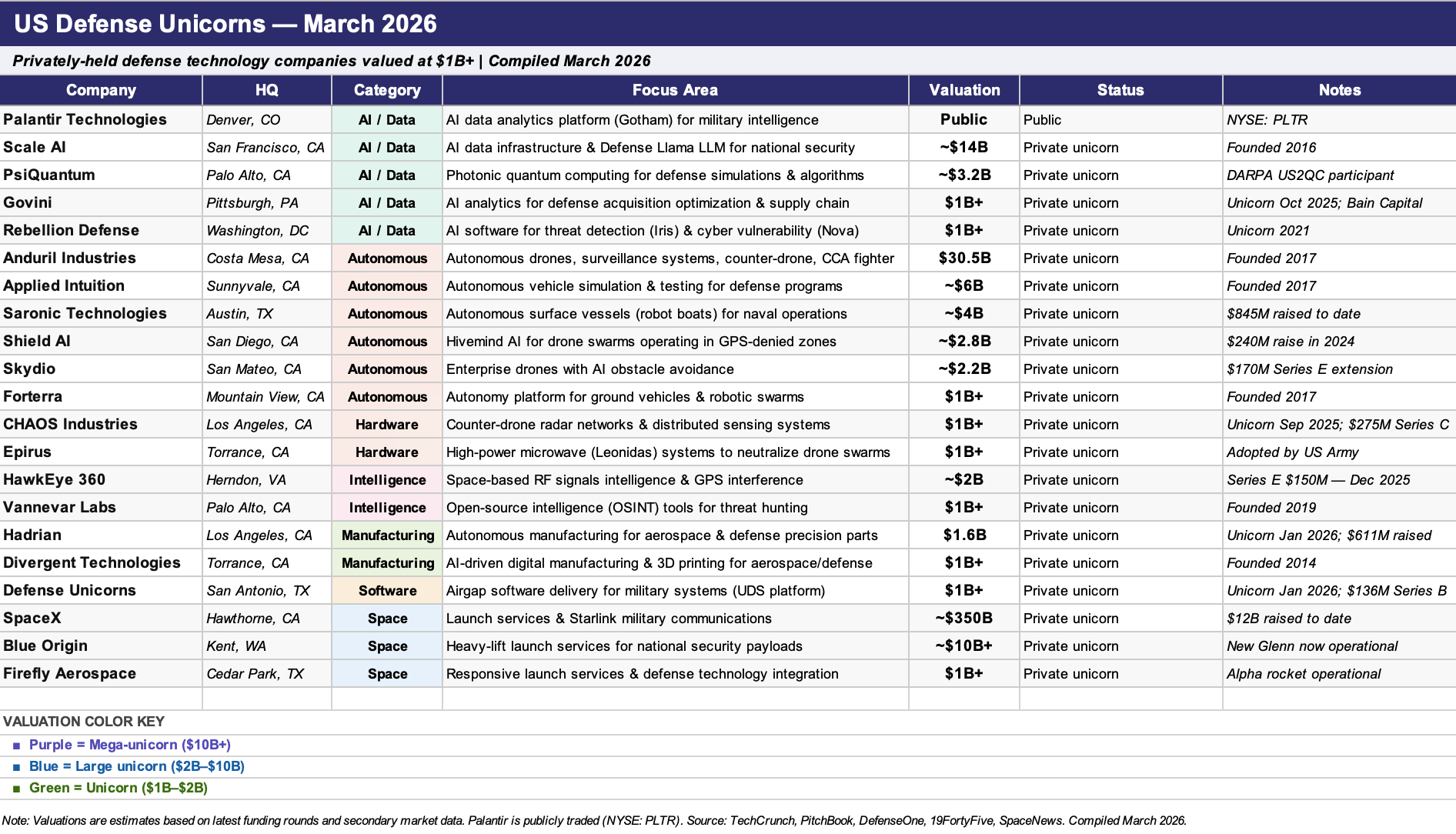
The defense tech ecosystem continues to mature and we developed this chart to make it clear just how far it’s come. With the most recent addition of Defense Unicorns to the list in January 2026, the U.S. now has a deep and diverse bench of $1B+ defense companies spanning AI, autonomy, manufacturing, and space. What was once a fragmented category is now a real market with density, repeat founders, and increasingly clear platform winners.
What’s notable isn’t just the number of companies, it’s the convergence. Players like Palantir Technologies and Scale AI define the AI/data layer, while Anduril Industries, Shield AI, and Skydio push autonomy forward. Meanwhile, companies like SpaceX and HawkEye 360 anchor the space and intel layer. This stack is starting to look less like a collection of startups and more like the foundation of a new defense industrial base.
For early stage investors, this landscape is more than a scoreboard, it’s a signal map. These unicorns show where real demand exists inside the Department of War and where budgets are actually getting deployed. Just as importantly, they represent the next generation of acquirers. Tracking what these companies prioritize, whether it’s AI infrastructure, edge compute, autonomy, or manufacturing, offers a forward looking view into M&A pathways and platform consolidation.
The takeaway: pay attention to this layer. Founders should build toward it. Investors should underwrite against it. And as each new company crosses the $1B threshold, it’s worth recognizing, not just as a milestone, but as another node strengthening the defense innovation ecosystem.

Nvidia announces Vera Rubin Space-1 chip system for orbital AI data centers
Nvidia’s latest push into orbital computing signals that space is no longer just a sensing layer, it’s becoming a compute layer. At its GTC event, CEO Jensen Huang unveiled space ready AI chips and systems designed to power data centers in orbit, with dramatically higher performance for in space inference and autonomous operations. The move builds on early proof points already happening: Nvidia powered satellites have successfully run and even trained AI models in orbit, demonstrating that “data center class” compute can operate off world. Together, this marks a shift from simply collecting data in space and sending it to Earth, to processing it directly in orbit.
This unlocks space data centers as a fundamentally new domain because it breaks the core bottlenecks of terrestrial AI infrastructure: energy, latency, and scale. Space offers effectively unlimited solar power and natural cooling dynamics, while enabling real time processing of satellite data without the need to downlink massive datasets. Just as importantly, it creates a new layer of infrastructure for autonomous systems where satellites, drones, and other edge assets can plug into orbital compute as part of a distributed “space cloud.” In that sense, Nvidia isn’t just launching chips, it’s helping define a new strategic domain where compute itself becomes geographically decoupled from Earth, with implications across defense, communications, and global AI competition.
New Space Force acquisition portfolios include space control, orbital warfare
The U.S. Space Force has finalized its mission focused acquisition portfolio structure under the Pentagon’s broader acquisition reform initiative, officially establishing offices dedicated to key warfighting domains as part of its acquisition modernization effort. Tom Ainsworth, performing the duties of the Air Force assistant secretary for Space Acquisition and Integration, announced that of the seven planned portfolio acquisition executive (PAE) offices, four are now formally stood up. These PAEs are designed to better align space acquisition with operational priorities, from sensing and targeting to communications and missile tracking. This enables joint data networks, battle management, and integrated cislunar capabilities through close cooperation with agencies like NASA and the Air Force Research Laboratory.
Four established Space Force PAEs:
Missile Warning and Tracking – manages constellations across all orbital regimes.
Infrastructure – responsible for data management, training/test capabilities, and personnel systems.
Battle Management, Command & Control, Communications & Space Intelligence handles networks, intelligence, and space domain awareness.
Satellite Communication and Position, Navigation & Timing – oversees military and commercial programs for SATCOM and PNT.
More links to explore:

Havoc Advances All-Domain Collaborative Autonomy Through Acquisitions of Mavrik and Teleo

Havoc is rapidly positioning itself as a leading “all-domain” autonomy platform by expanding beyond its roots in maritime systems into air and ground operations. Through the acquisitions of drone company Mavrik and autonomous heavy machinery firm Teleo, the company is building a unified software stack that allows a single operator to control and coordinate fleets of autonomous systems across sea, air, and land in real time. The goal is to replace siloed, domain specific tools with a single interface where heterogeneous assets can operate as a synchronized, collaborative force.
At the core of this strategy is “supervised autonomy” keeping humans in the loop while enabling one operator to oversee many machines simultaneously. This model addresses both operational efficiency and safety concerns, and has already been demonstrated at scale in maritime environments. Backed by significant venture funding and growing demand from defense and commercial customers, Havoc’s expansion reflects a broader shift toward integrated, AI driven autonomy systems that can deliver coordinated, multi domain capabilities and potentially redefine how both militaries and industrial operators deploy autonomous fleets.
Thanks for reading Securing Our Future! Subscribe for free to receive new posts and support our work.