
Battlefield AI: The Emerging Doctrine Divide
3 June 2026 - A Weekly Publication by New North Ventures

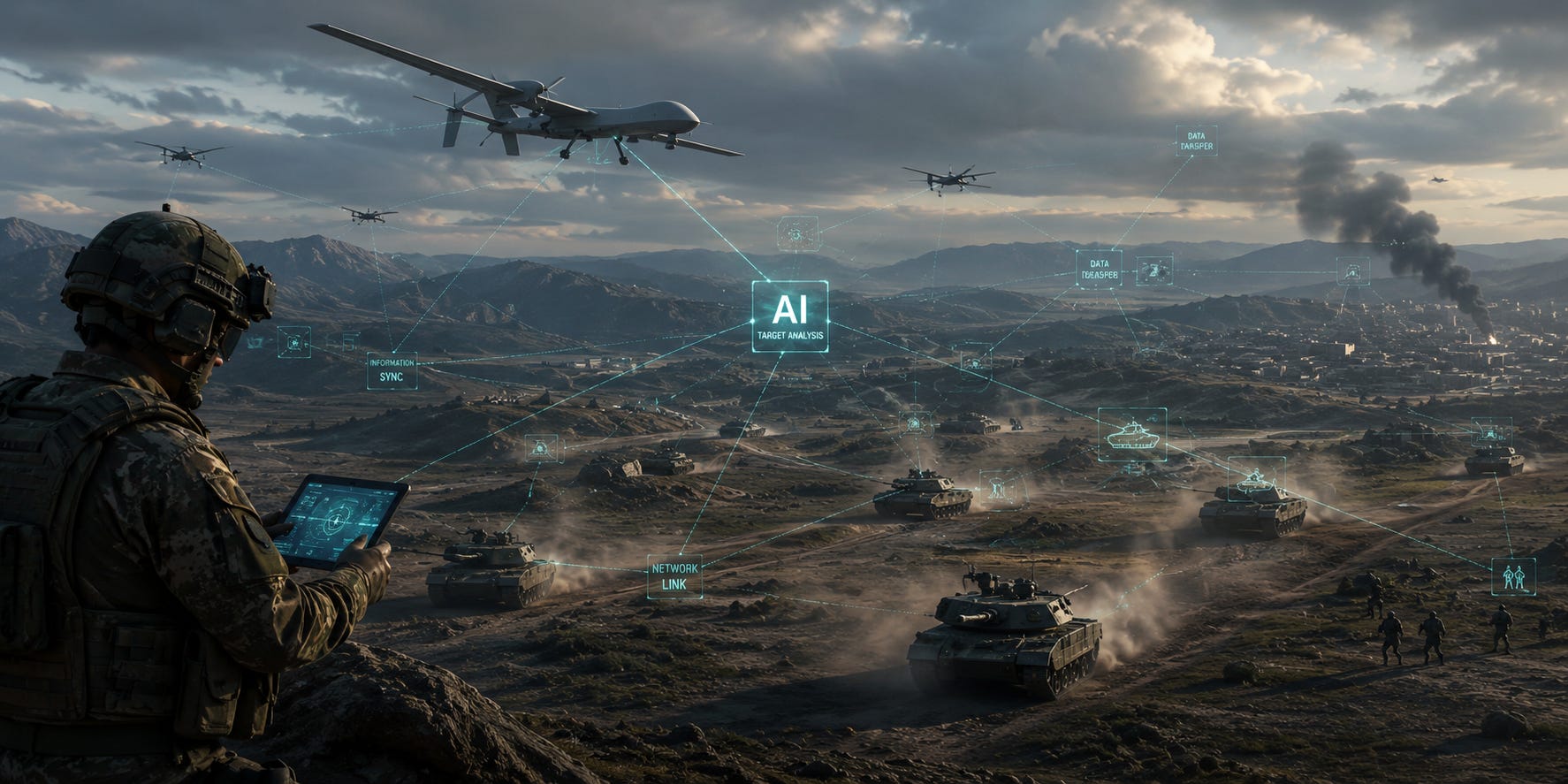
As Pentagon pushes for battlefield AI, some military leaders urge caution
The Pentagon’s aggressive push toward battlefield AI is meeting resistance from within its own ranks, creating a significant doctrinal divide over the role of autonomous decision making in combat operations. While the Department of War continues to accelerate AI integration across targeting, reconnaissance, and command systems, a growing faction of senior military leaders is publicly urging restraint, particularly around lethal autonomous weapons and AI driven strike decisions. The tension reflects a broader uncertainty about the operational, ethical, and strategic implications of delegating life and death choices to algorithmic systems in high stakes environments.
What makes this moment notable is not the presence of skepticism, which has always existed around emerging military technologies, but rather the timing and seniority of those voicing concern. This is active duty and recently retired flag officers questioning whether the current pace of AI deployment is outstripping the military’s ability to validate performance, understand failure modes, or maintain meaningful human control in dynamic combat scenarios. The concerns span technical reliability, adversarial manipulation, escalation risks, and the erosion of human judgment in contexts where context, culture, and proportionality matter as much as precision.
The broader implication for defense technology investors is that the pathway from prototype to production is becoming more contested, even within the customer base. Autonomous systems companies can not assume that capability demonstrations alone will unlock procurement at scale. There is a widening gap between what the technology can do and what military institutions are organizationally, legally, and culturally prepared to adopt. The winners in this market will be companies that build not just performance, but verifiability, explainability, and graduated autonomy into their systems. Those that can help the Defense Department navigate the gap between ambition and doctrine will capture the long term value, while those that push purely on capability may find themselves technically impressive but operationally sidelined.

US, UK, Australia launch joint underwater drone project by 2027
The United States, United Kingdom, and Australia have announced a joint initiative to develop and field underwater autonomous systems by 2027 under the AUKUS security framework. The program aims to accelerate the deployment of unmanned undersea vehicles for intelligence, surveillance, reconnaissance, and potentially offensive missions across contested maritime domains. The collaboration will focus on interoperability, shared development timelines, and coordinated procurement pathways. This signals that underwater autonomy is becoming a trilateral strategic priority rather than a series of parallel national programs.
The move reflects growing recognition that the subsurface domain is becoming as contested and technologically dynamic as airspace. Undersea drones offer persistent monitoring of critical infrastructure, submarine tracking, mine countermeasures, and distributed naval presence without the cost, risk, or manpower requirements of crewed platforms. For dual use investors, the signal is clear: underwater autonomy is transitioning from experimental capability to core defense infrastructure, with allied interoperability as a forcing function for standardization and scale. Companies building modular, software defined underwater platforms with open architectures stand to benefit as AUKUS procurement accelerates over the next 24 months.
America’s Next Arsenal Will Be Built by Startups
A new narrative is solidifying in Washington and across defense policy circles: the next generation of American military capability will not come primarily from traditional primes, but from venture backed startups building software driven, modular, and rapidly iterating platforms. The argument centers on speed, cost, and adaptability. Startups are fielding drones, AI targeting systems, counter UAS platforms, and autonomous vehicles in months rather than years, at unit costs orders of magnitude below legacy programs. Lessons from Ukraine, where commercial and startup built systems have defined battlefield outcomes, are accelerating this shift in procurement philosophy.
What matters here is not just the technology, but the industrial and cultural transformation this represents. Defense startups are forcing the Pentagon to rethink how it buys, tests, and integrates new capabilities. Companies like Anduril, Shield AI, and dozens of others are building not just products but entirely new models of defense production, ones rooted in continuous software updates, modular hardware, and venture scale rather than cost plus contracting. For investors, this is the industrial base thesis playing out in real time. The companies that can combine technical performance with the operational maturity to navigate government bureaucracy, security requirements, and allied interoperability will define the next decade of defense innovation. Those that cannot will remain impressive demos without pathways to production.
More links to explore:

Auriga Space | California firm rethinks missile defense without rocket motors
Auriga Space is developing a novel missile defense concept that replaces traditional rocket powered interceptors with electromagnetic launch systems capable of accelerating projectiles to hypersonic speeds using electricity. The approach aims to address a growing challenge in U.S. air and missile defense: interceptor production is constrained by reliance on solid rocket motors and a fragile domestic supply chain for key propellants. Backed by contracts from the Missile Defense Agency and AFWERX, Auriga argues that reusable electromagnetic launchers could dramatically lower the cost per interception while reducing dependence on scarce rocket components. The company plans to begin hypersonic testing in 2026, with the long term vision of deployable, containerized launch systems that could provide more scalable and affordable missile defense against drones, missiles, and other emerging threats.
HawkEye 360 draws broad Wall Street support following IPO debut
Space based signals intelligence company HawkEye 360 is receiving strong attention from Wall Street following its recent IPO, with several major banks initiating coverage and most assigning Buy, Outperform, or Overweight ratings. Investors are drawn to the company’s unique position as a commercial provider of radio frequency (RF) geospatial intelligence, using a constellation of more than 30 satellites to detect and analyze signals from radar systems, communications networks, maritime vessels, and GPS jammers. Analysts see HawkEye as a beneficiary of rising global defense spending, growing demand for space based intelligence, and the shift of ISR missions from traditional airborne platforms to satellites. While some firms caution that the stock’s valuation already reflects much of its growth potential, the broader consensus is that HawkEye is well positioned to capitalize on an expanding national security space market expected to grow significantly over the coming decade.
Thanks for reading Securing Our Future! Subscribe for free to receive new posts and support our work.